Yes! The sooner you establish a routine, the faster your puppy will adjust to its new home—and the easier it will be for both of you. A consistent schedule helps set expectations for behavior, housetraining, and daily activities, making life smoother for everyone.

Do I Need to Create a Schedule for My Puppy?

Yes! The sooner you establish a routine, the faster your puppy will adjust to its new home—and the easier it will be for both of you. A consistent schedule helps set expectations for behavior, housetraining, and daily activities, making life smoother for everyone.

Puppy Crate Training Schedule

  • Flexibility is key: Adapt the schedule to fit your work hours, meal times, and when you can take your puppy outside. 
  • Observe your puppy: Pay attention to signs that your puppy needs to go to the bathroom, like restlessness or sniffing around, and take them out accordingly. 
  • Gradually increase the time between breaks: As your puppy gets better at holding their bladder, you can gradually increase the time between potty breaks. 
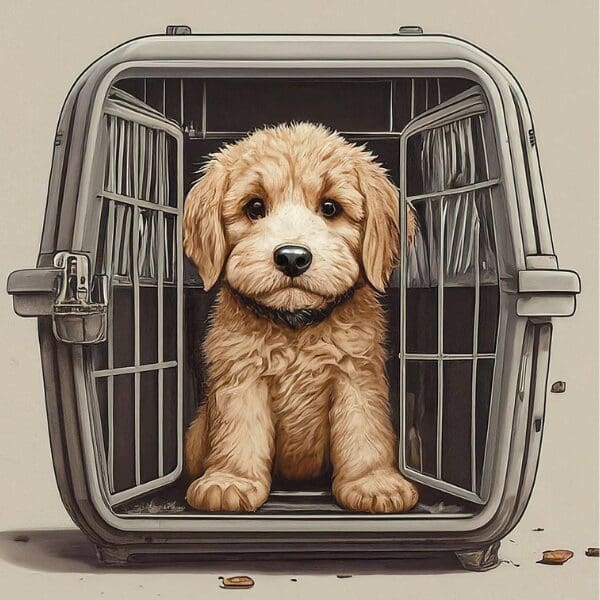
Setting clear routines now will prevent bad habits later. Below is a sample schedule to get you started, but feel free to adjust it based on your puppy’s needs.

The sample schedule below is a good place to start; you may need to tailor it to suit your puppy and daily schedule.

Example Crate Training Schedule

TIME

ACTIVITY

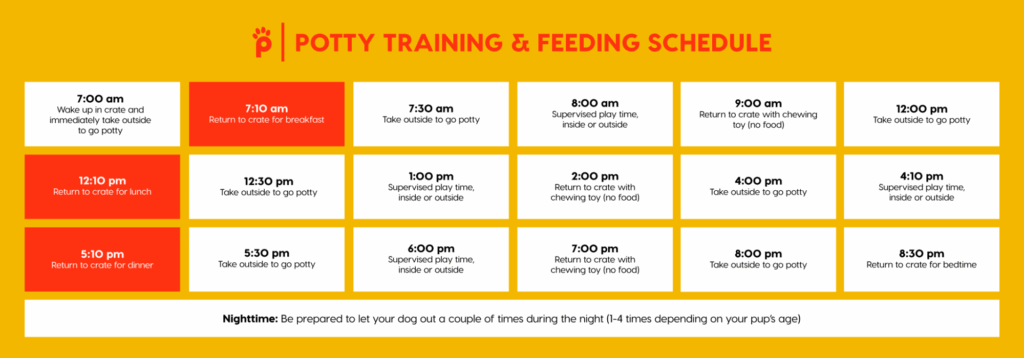
7:00 AM Wake up in the crate and immediately take outside to go potty
7:10 AM Return to crate for breakfast
7:30 AM Take outside to go potty
8:00 AM Supervised playtime, inside or outside
9:00 AM Return to crate with chewing toy (no food)
12:00 PM Take outside to go potty
12:10 PM Return to crate for lunch
12:30 PM Take outside to go potty
1:00 PM Supervised playtime, inside or outside
2:00 PM Return to crate with chewing toy (no food)
4:00 PM Take outside to go potty
4:10 PM Supervised playtime, inside or outside
5:10 PM Return to crate for dinner
5:30 PM Take outside to go potty
6:00 PM Supervised playtime, inside or outside
7:00 PM Return to crate with chewing toy (no food)
8:00 PM Take outside to go potty
8:30 PM Return to crate for bedtime
Nighttime: Be prepared to let your dog out a couple of times during the night (1-4 times depending on your pup’s age)

Download & Print Image Version

Sample Puppy Feeding Schedule

  • Frequent small meals: Young puppies need smaller meals more often due to their fast metabolism. 
  • Consistency is key: Try to feed your puppy at the same time each day.
  • Monitor weight: Adjust the amount of food based on your puppy’s weight and activity level. 
  • Access to fresh water: Ensure your puppy has access to clean drinking water. We recommend pulling up the water a couple of hours before bedtime while potty training.

Your Puppy’s Daily Schedule

Feeding Schedule

Unlike adult dogs that eat once or twice a day, puppies need three meals a day to support their rapid growth and energy levels. A simple way to remember this is to align their mealtimes with your own—breakfast, lunch, and dinner. Always provide fresh water, cleaning and refilling the bowl regularly.

Potty Breaks

To help with housetraining, take your puppy outside every two to four hours and after any major activity change, such as waking up, playing, or eating. A consistent routine will minimize accidents and teach them where to go.

Naps & Bedtime

Puppies sleep a lot—16 to 18 hours a day—so scheduled nap times are important. Make sure they have a quiet, comfortable space to rest, away from distractions. Teach family members, especially young children, to let the puppy sleep undisturbed. A crate in a quiet area can be a great way to ensure they get the rest they need.

Puppy Training Toolbox

  • Crate or Playpen: Provides a "den" for safety, prevents destructive chewing when unsupervised, and is the gold standard for potty training. ( Training Link)
  • Enzyme Cleaner: Essential for accidents; standard soaps don't remove the scent that attracts puppies back to the same spot.
  • Potty Bells: A bell hung by the door that the puppy learns to ring when they need to go outside, start by taking their paw to hit the bells before you take them out.
  • Baby Gates: Used to block off "forbidden" areas like carpeted rooms or stairs. 
  • Tether Leash Training? A leash either clipped to your waist using a carabiner or you can buy a special hands free leash that clips around your waist.


The Housebreaking Toolbox

Core Benefits of Umbilical Cord Training

  • Faster Housebreaking
    Because puppies naturally avoid soiling the area where they rest, keeping them close allows you to quickly spot early potty signals like sniffing or circling — and get them outside before accidents happen.
  • Better Behavior Management
    Limiting free roaming prevents access to shoes, furniture, and other “off-limits” items. Instead of correcting bad habits later, you stop them before they form.
  • Teaching a Calm “Settle”
    Puppies learn that they don’t need constant entertainment. Staying near you helps them practice relaxing and self-regulating rather than demanding attention nonstop.
  • Stronger Bonding
    Spending consistent, structured time together builds trust, security, and connection — setting the foundation for a confident, well-adjusted adult dog.


Puppy Resources - PDF Downloads

Socialiazation Checklist

Download the Socialization Checklist PDF for New Puppy Owners below.

VACCINE PROTOCAL

To protect your pet from contagious diseases, keep his essential vaccinations up-to-date.

Crate Training Schedule – Home All Day

Download the 12 day  crate training schedule

Crate Training Schedule – Owner Works Full-time ipsum

Download the 12 day crate training schedule

More Puppy Related Blog Posts

A close-up view of dog bone-shaped biscuits in a stainless steel bowl on a wooden surface.
Changing your dog’s food is sometimes necessary due to age, activity level, weight, […]
Welcoming a new puppy into your home is an exciting milestone, but it’s […]
Dosage Chart for Deworming Litters of Puppies or Multiple Adult Dogs with 50 mg/mL Pyrantel Pamoate!
Learn how to safely and effectively deworm your dogs and puppies with Pyrantel […]

Tuff Mutt - Hands Free Bungee Leash, GreAt for UMBILICAL CORD TRAINING PUPPIES

The umbilical cord training technique is a vigilant supervision-based program that prevents bad habits from taking root. It’s more than just a housebreaking method; it’s an excellent alternative to crate training or other types of confinement.

  • Hands-free bungee leash features a 48-inch lead that extends up to 60 inches, and is designed to absorb shock.
  • Leash attaches to the included adjustable waist belt,
  • Two control handles can be easily grabbed to help keep your dog close in crowded areas.

Mammoth Flossy Chews Rope Tug – Premium Cotton

Why You Need It: Playing tug is a great way to tire out your puppy, while also providing a fun educational experience that builds engagement and a bond.

  • Extra Large Non-toxic rope toy!
  • Must-have for teething puppies!
  • Puppies can get bored with toys fast so it's nice to have a large variety of them to keep your pup engaged and entertained